








Last updated: June 2026 · Written by Sahina Ibrahim, Co-Founder, NUHR Home — Sahina has developed and curated every fragrance in the NUHR range since the brand's founding in 2016. She leads all in-house formulation at NUHR's Blackburn studio.
Cooking smells linger because volatile odour molecules — released during cooking — are absorbed directly into soft furnishings: curtains, sofas, cushions, rugs and upholstered chairs. Fabric acts as a reservoir, slowly releasing these molecules back into the air for hours or days after cooking has finished. Ventilation removes airborne smoke but does not extract molecules already absorbed into fabric. This is why the smell persists even after windows have been open for an hour. The most effective approach is to displace absorbed molecules with a competing aromatic — specifically one with resinous, combustion-based chemistry, which is why oud incense is considerably more effective than candles or sprays.
The Science: Why Fabric Holds Cooking Smells
When you cook — particularly with spices, high-heat frying, fish or strongly aromatic ingredients — you release a large volume of volatile organic compounds (VOCs) into the air. These are the molecules your nose detects as smell. Some remain airborne temporarily and are removed by ventilation. But a significant proportion are hydrophobic (oil-attracting) molecules that do not disperse easily in air. Instead, they bind to surfaces.
Soft furnishings — curtains, upholstered sofas, cushion covers, rugs, carpets, clothing left in the room — have an enormous combined surface area relative to hard floors or walls. Their fibres provide millions of microscopic binding points for these volatile molecules. The absorbed molecules then off-gas slowly back into the room air over hours or days, producing a persistent low-level odour that ventilation alone cannot solve.
This is why cooking smells are worse in homes with a lot of soft furnishings, and why the smell can still be noticeable the following morning even after thorough ventilation the previous evening.
Which Fabrics Hold Smell the Longest?
Not all fabrics absorb and retain odours equally. As a general rule, heavier, denser fabrics with more surface area per gram hold smells longer. The times below are approximate — actual retention varies significantly by cooking intensity, room ventilation and fabric condition:
| Surface / Fabric | Odour Retention | Why |
|---|---|---|
| Thick curtains (velvet, chenille, lined) | Very high — 12–48 hours | Dense fibres, large surface area, rarely washed |
| Upholstered sofa | High — 8–24 hours | Porous foam beneath fabric holds molecules within the structure |
| Carpet and rugs | High — 6–24 hours | Deep pile traps molecules; floor-level positioning receives settling particles |
| Cushions and throws | Medium–high — 4–12 hours | Regularly disturbed (releasing molecules back) and moved around the room |
| Clothing left in room | High — 6–24 hours | Fine fibres absorb readily; smell transfers from room to person |
| Wooden furniture (unfinished) | Low–medium — 2–6 hours | Some absorption but hard surface releases more easily |
| Hard floors, tiles, glass | Low — 1–2 hours | Minimal absorption; smell is primarily airborne in these spaces |
Why Open-Plan UK Homes Make This Worse
The shift toward open-plan kitchen-living-dining layouts — common in UK homes built or renovated over the last 20 years — has made cooking smell management significantly harder. In a traditional layout with a separate kitchen and a closed door, cooking smells are largely contained in one room. In an open-plan space, the same cooking smells are free to circulate across the entire soft-furnishing-rich living area.
A family cooking a curry, stir-fry or spiced dish in an open-plan space is essentially diffusing those molecules across every sofa cushion, curtain panel and rug in the entire ground floor. Extraction hoods help considerably during cooking but do not eliminate the problem — they capture rising steam and direct smoke, but significant molecular dispersal occurs at surface level throughout the room.
This is particularly relevant in multicultural British households where South Asian, Middle Eastern, East African and South East Asian cooking forms a regular part of home life. Aromatic spice-heavy cooking — cumin, coriander, fenugreek, cardamom, fish sauce, gochujang — produces especially persistent odour compounds. These are the homes where the cooking-smell problem is most acute, and where a genuinely effective solution matters most.

Why Ventilation Alone Doesn't Work
Opening windows is the right instinct — but it only solves half the problem. Ventilation is highly effective at removing airborne volatile molecules while cooking is in progress, which is why turning on an extraction hood and opening a window during cooking is genuinely useful. But by the time cooking is finished, a large proportion of the molecules have already been absorbed into fabric.
Opening windows after the fact circulates fresh air through the room and slowly draws out the airborne fraction — the smell in the air. But it cannot extract molecules that have already bonded to fibres. Those will continue off-gassing back into the room air even with windows fully open, sometimes for 12–24 hours.
This explains a pattern many people recognise: they open windows fully for an hour, the room smells fine, they close the windows and go to bed — and in the morning the smell has returned. The smell in the morning is coming from the fabric, not the air.
Why Candles and Air Fresheners Don't Solve the Problem
Scented candles and aerosol air fresheners mask airborne odour — they add a competing fragrance molecule to the air and temporarily override the smell your nose detects. They do not remove or neutralise the molecules absorbed in fabric.
This is why spraying air freshener after cooking produces an immediate effect that fades within 20–30 minutes. Once the competing molecules dissipate, the cooking smell molecules (which are still slowly off-gassing from the fabric) reassert themselves. You have masked the symptom, not addressed the source.
Why Oud Incense Works Differently
Oud-based incense — whether bakhoor chips or oud incense cones — works through a different mechanism. Burning oud releases a large volume of aromatic resinous molecules via combustion. These molecules are themselves hydrophobic and surface-active: they actively deposit onto and are absorbed by the same fabric surfaces that hold cooking smells.
The practical effect is that oud aromatic compounds compete with cooking odour molecules at the fibre level — tending to dominate over the less stable cooking compounds and shifting the dominant scent in the fabric. This is meaningfully different from masking; the oud is depositing into the same surfaces where the cooking smell resides, not just overriding it temporarily in the air above.
This is why bakhoor has been used in Middle Eastern households for centuries as a practical household fragrance tool, not merely a ceremonial one. In Gulf homes where spice-heavy cooking is daily routine, bakhoor is used specifically to refresh the home fragrance — it is a functional as much as a ritualistic practice.
The Most Effective Approach: Timing and Placement
Timing
The most effective window is during or immediately after cooking — before cooking odours have fully settled into fabric. Burning an oud cone in the living area while cooking is in progress (or within 15 minutes of finishing) means oud fragrance is competing in real-time rather than trying to override odours that have already been absorbed.
Placement
Place the incense cone in the room where the soft furnishings are, not in the kitchen. The kitchen typically has hard surfaces that release smells easily; the living room is where the persistent smell resides. A cone on the coffee table or side table at the living room's centre provides the best coverage in a typical layout.
Combination approach
For the most persistent cooking smells (heavy frying, fish, fermented ingredients), combining approaches works best: ventilate immediately during and after cooking, then close the room slightly and burn 1–2 oud cones for 20–30 minutes, then ventilate again to clear the smoke while the aromatic compounds remain in the fabric.

Which NUHR Cone Is Best for Cooking Smells?
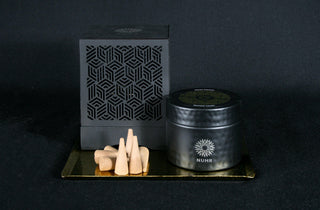
All NUHR oud incense cones are effective for cooking smell management because they are all combustion-based oud formats. The choice between them is a matter of fragrance preference:
- Oud Arabia — clean, direct oud with minimal sweetness. Good if you want to refresh rather than strongly scent the room.
- Rose & Oud — the most popular all-round option. Warm, welcoming, contrasts well with cooking smells.
- Amber — warmer, sweeter, works well in the evening after cooking.
- Tobacco & Oud — deep and smoky; best suited to confident oud users.


Frequently Asked Questions
How long does it take for cooking smells to fully leave fabric?
Without intervention, cooking smell molecules in soft furnishings can take many hours to fully off-gas in a well-ventilated room — often longer with heavier fabrics or more pungent cooking. This is why smells that seem to have cleared the previous evening can be noticeable again the next morning.
Will incense cones leave a smoky smell in my home?
Oud incense cones produce a fragrant smoke, not a generically smoky one. After a cone burns out and you ventilate the room, what remains in the fabric is the oud fragrance — woody, resinous, spiced — rather than a flat, acrid residue.
Can I use bakhoor instead of cones for cooking smell removal?
Yes — bakhoor is equally effective and produces a more intense result. The higher smoke volume from bakhoor means more aromatic molecules are deposited into fabric surfaces. For everyday after-cooking freshening, most UK households find cones more practical. See: How to Use Bakhoor at Home.
Key Takeaways
- Cooking smells persist because odour molecules absorb into soft furnishings — ventilation clears the air but cannot extract molecules already in fabric
- Candles and air fresheners mask airborne smell only — they do not address molecules already absorbed into fabric
- Combustion-based oud incense produces smoke particles that deposit into the same fabric surfaces — competing with cooking smell at the source
- Burn during or within 15 minutes of cooking for best results; place the cone in the living area where soft furnishings are
Recommended Next Reading
→ How to Remove Cooking Smells from Your Home Using Oud — the practical action guide
→ How Long Does Oud Last? Fragrance Longevity Explained — the same fabric-absorption mechanism explained
→ New to Oud? Start Here — the full orientation guide